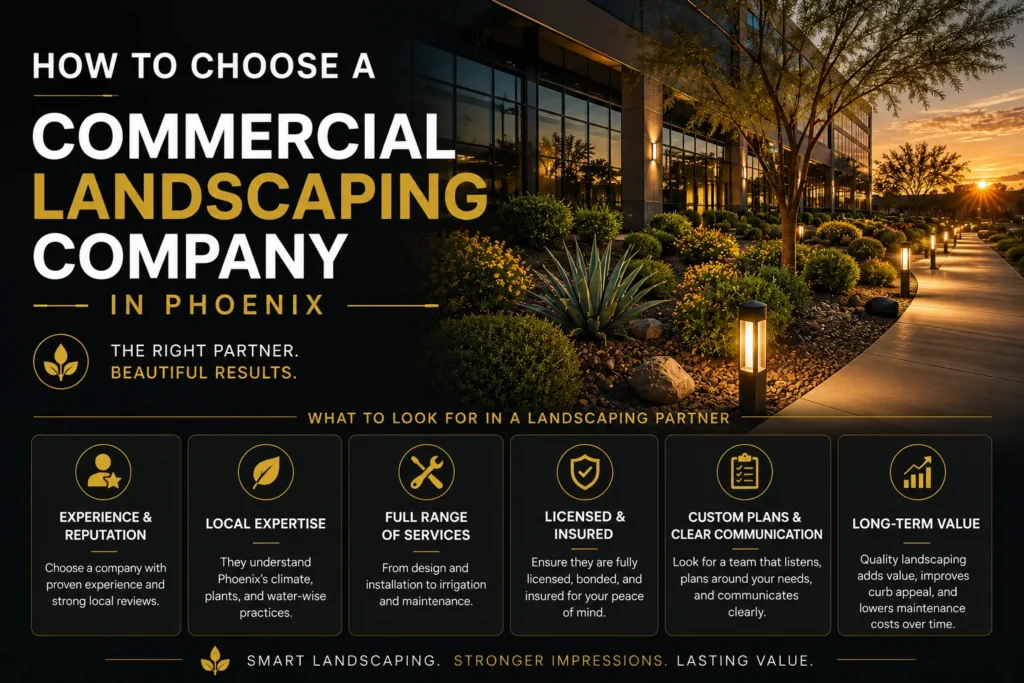
Choosing a commercial landscaping company in Phoenix is about more than finding someone who can mow, trim, and clean up the property.
For property managers, HOA boards, apartment operators, office property owners, retail centers, and managed commercial properties, the right landscaping company can protect curb appeal, reduce complaints, prevent irrigation issues, support tenant satisfaction, and help the property maintain a professional appearance year-round.
The wrong company can create the opposite problem.
Missed visits, poor communication, weak irrigation knowledge, slow response times, untrained crews, and unclear service expectations can quickly turn landscaping into a recurring management headache.
Phoenix adds another layer of complexity. Extreme heat, irrigation dependence, monsoon storms, palm maintenance, tree safety, turf stress, and water efficiency all matter when choosing a landscaping partner.
This guide explains how to choose a commercial landscaping company in Phoenix and what property managers should evaluate before signing a service agreement.
Start With Commercial Landscaping Experience
Commercial landscaping is different from residential yard maintenance.
A company that does good residential work may not be prepared for the demands of HOAs, apartment communities, office properties, retail centers, medical facilities, and managed commercial sites.
Commercial properties require consistent scheduling, trained crews, clear communication, insurance, documentation, property awareness, and the ability to maintain a larger site without constant supervision from the property manager.
Before hiring a landscaping company, ask what types of commercial properties they currently maintain.
A strong commercial landscaping company should understand the difference between maintaining an apartment community, an HOA entrance, a retail center, and an office complex. Each property type has distinct traffic patterns, visibility requirements, irrigation needs, and service expectations.
Make Sure the Company Understands Phoenix Landscaping Conditions
Phoenix-area landscapes face conditions very different from those in many other markets.
Extreme summer heat can quickly stress turf, shrubs, and trees, as well as irrigation systems. Monsoon storms can create fallen branches, debris buildup, drainage problems, and safety concerns. Decorative rock, desert plants, palms, turf areas, and irrigation systems all need the right maintenance approach.
A commercial landscaping company in Phoenix should understand how local conditions affect:
- Irrigation schedules
- Plant health
- Turf performance
- Tree safety
- Palm maintenance
- Seasonal cleanup
- Water usage
- Storm preparation
- Landscape bed condition
- Long-term maintenance planning
This local knowledge matters because a generic maintenance approach can fail quickly in Arizona.
A property may look fine in March but start declining by June if the irrigation system is not properly monitored. A tree that looks manageable in spring can become a safety concern during monsoon season if trimming and inspection are ignored.
Review Insurance Before Signing a Contract
Insurance is one of the most important things to verify before hiring a commercial landscaping company.
Commercial properties carry more risk than residential yards. Crews may work near parked vehicles, walkways, pool areas, tenant entrances, common areas, signage, lighting, and irrigation systems.
Property managers should confirm that the landscaping company carries proper insurance for commercial work.
Request current proof of insurance and ensure the coverage matches the type of property being maintained. This is especially important for HOAs, apartment communities, and higher traffic commercial properties where residents, tenants, employees, and visitors are regularly present.
Insurance should not be treated as a small administrative detail. It is part of protecting the property, the ownership group, and the management company.
Evaluate Communication Before You Evaluate Price
Poor communication is one of the most common reasons property managers change landscaping vendors.
A low price does not help much if the property manager has to chase updates, ask whether the crew showed up, repeatedly report the same issues, or explain basic expectations every month.
A reliable commercial landscaping company should have a clear communication process.
Before signing a contract, ask how service concerns are handled, who the main point of contact will be, how quickly the company responds to requests, and whether property updates are documented.
Good communication usually shows up before the contract is signed.
If a company is slow to respond, vague in its proposals, unclear about scope, or difficult to schedule during the sales process, those same habits may persist after the agreement begins.
Look for Service Consistency
Commercial landscaping depends on consistency.
One good cleanup visit is not enough.
Property managers need a company that can maintain the property week after week without significant quality fluctuations. Consistency is especially important for apartment communities, HOA properties, retail centers, and office sites where appearance affects residents, tenants, customers, and visitors.
Ask how the company manages crew scheduling, property notes, recurring tasks, inspections, and service quality.
A strong landscaping company should know what needs to happen on every visit and what should be checked less frequently. The crews should understand the property layout, high-priority areas, known irrigation concerns, and visibility standards.
Inconsistent service often creates visible problems, such as uneven trimming, missed corners, overgrown edges, debris buildup, weeds, dead plants, and frustrated residents or tenants.
Ask About Irrigation Knowledge
In Phoenix, irrigation knowledge is not optional.
It is one of the biggest differences between basic landscape maintenance and professional commercial landscape care.
Many commercial landscape problems begin with irrigation issues. A broken line, a clogged emitter, a bad valve, a controller problem, a pressure issue, or a dry zone can quickly damage plants and turf during hot weather.
A good commercial landscaping company should be able to identify visible irrigation problems during routine maintenance and explain how irrigation repairs are handled.
This does not always mean every repair is included in the monthly contract. Many landscaping agreements separate irrigation repair from standard maintenance. What matters is clarity.
Before signing, ask:
- Does the company inspect irrigation during routine visits?
- How are irrigation problems reported?
- Are repairs included or billed separately?
- How quickly can irrigation issues be addressed?
- Does the company understand Phoenix summer watering demands?
A landscaping company that ignores irrigation will eventually create larger problems for a Phoenix property.
Compare Response Times
Response time matters in commercial landscaping.
Property managers often deal with urgent issues. A broken irrigation line, fallen tree limb, storm debris, dead plant material near an entrance, or resident complaint cannot always wait until the next scheduled visit.
Before choosing a company, ask how quickly they respond to service requests and emergency issues.
This is especially important for:
- HOA communities
- Apartment properties
- Medical facilities
- Retail centers
- Office properties
- Properties with mature trees
- Properties with large irrigation systems
Slow response times can lead to higher repair costs, resident complaints, safety concerns, and avoidable damage.
The best commercial landscaping companies set clear expectations. They do not overpromise, but they communicate promptly and handle urgent issues with professionalism.
Make Sure Reporting Is Part of the Relationship
Property managers need visibility.
They should not have to guess what was completed, what was noticed, or what needs attention.
Reporting need not be complicated, but a commercial landscaping company should have a way to communicate important updates. This may include service notes, inspection feedback, photos, recommendations, irrigation concerns, tree safety observations, or upcoming seasonal needs.
Reporting is especially valuable for HOAs and managed properties because property managers may need to communicate with boards, owners, residents, or asset managers.
Clear reporting helps prevent misunderstandings. It also creates a record of issues, recommendations, and completed work.
Understand What Is Included in the Contract
One of the biggest mistakes property managers make is assuming all landscape-related work is included in the monthly price.
Most commercial landscaping contracts include routine maintenance, but not every service is included by default.
A typical contract may cover mowing, edging, blowing, shrub trimming, weed control, debris cleanup, basic bed care, and general appearance maintenance.
Other services may be separate, including irrigation repair, major tree trimming, palm trimming, plant replacement, landscape renovations, decorative rock installation, seasonal color, hardscape work, and emergency storm cleanup.
This is not a problem if the contract is clear.
Problems happen when the scope is vague.
Before signing, review exactly what is included, what is excluded, and how additional work is approved.
A professional landscaping company should be able to explain the scope in plain language.
Compare Proposals Carefully
When property managers collect multiple landscaping proposals, the cheapest option is not always the best option.
A lower monthly price may exclude important services, reduce visit frequency, limit irrigation oversight, or provide less responsive communication.
When comparing proposals, look beyond the total cost. Review what each company includes, how often they visit, how they handle irrigation, how quickly they respond, and how clearly they communicate. The right company is the one that fits the property’s needs, not just the lowest price.
Review the service frequency, property scope, irrigation responsibilities, tree and palm expectations, cleanup standards, reporting process, response times, seasonal planning, and exclusions.
Two quotes may look similar at first glance, but one may provide much better long-term value because the company understands the property, communicates clearly, and prevents problems before they become expensive.
The right question is not only, “Which company is cheaper?”
The better question is, “Which company will keep the property looking better with fewer problems, fewer complaints, and fewer surprises?”
Consider Property Type Experience
Not every commercial property has the same needs.
A company that works well for a small office building may not be the right fit for a large apartment community. A company that handles apartments may not fully understand HOA board expectations.
For HOA communities, the landscaping company should understand resident visibility, common area standards, entrance presentation, irrigation control, tree safety, and board communication.
For apartment communities, the company should understand leasing appeal, pool-area presentation, pet areas, high foot traffic, resident complaints, and fast-response needs.
For retail centers, the company should understand customer visibility, parking lot presentation, storefront appearance, signage areas, and debris control.
For office and medical properties, the company should understand professional appearance, access points, walkways, shaded areas, and tenant expectations.
Choosing a company with the right property type experience helps reduce friction after the contract begins.
Watch for Red Flags
Property managers should be cautious when a landscaping company offers a vague proposal, avoids questions, fails to explain exclusions, lacks commercial references, has unclear insurance, or quotes a price that seems unusually low.
Other warning signs include poor communication during the estimate process, no clear point of contact, no explanation of irrigation responsibility, no seasonal maintenance plan, and no process for reporting property issues.
Low prices can be tempting, but they often create higher costs later if service quality, communication, and irrigation oversight are weak.
In Phoenix, poor landscaping oversight can lead to dead plants, damaged turf, water waste, storm cleanup issues, tenant complaints, and avoidable repair costs.
Ask the Right Questions Before Hiring
Before choosing a commercial landscaping company in Phoenix, property managers should ask practical questions.
- How much commercial experience do you have?
- What types of properties do you maintain?
- Are you insured for commercial landscaping work?
- How often will crews service the property?
- Who will be the main point of contact?
- How are irrigation problems handled?
- What is included in the monthly contract?
- What services are billed separately?
- How quickly do you respond to urgent issues?
- Do you provide service updates or reporting?
- How do you prepare properties for summer and monsoon season?
The answers should feel clear, direct, and realistic.
A company that understands commercial landscaping will not struggle to explain how its services work.
Choose a Partner, Not Just a Vendor
Commercial landscaping works best when the company acts like a property partner.
That means the landscaping team is not only completing routine tasks. They are watching the property, identifying issues early, communicating clearly, planning for seasonal needs, and helping the property manager maintain a clean, safe, and attractive landscape.
For Phoenix properties, this partnership matters because the landscape is constantly affected by heat, irrigation demands, storm conditions, plant stress, and property use.
A reliable partner helps reduce the number of landscaping problems that reach the property manager’s desk.
Final Thoughts
Choosing a commercial landscaping company in Phoenix requires more than comparing monthly prices.
Property managers should look for commercial experience, proper insurance, clear communication, consistent service, irrigation knowledge, reasonable response times, useful reporting, and a strong understanding of HOAs, apartment communities, and managed commercial properties.
The right company will help protect property appearance, reduce complaints, manage irrigation issues, prepare for seasonal challenges, and keep the landscape functioning as part of the property’s overall value.
A landscaping company should make property management easier, not harder.
When the service is consistent, communication is clear, and the company understands Phoenix commercial landscapes, property managers can spend less time chasing problems and more time focusing on the property itself.