
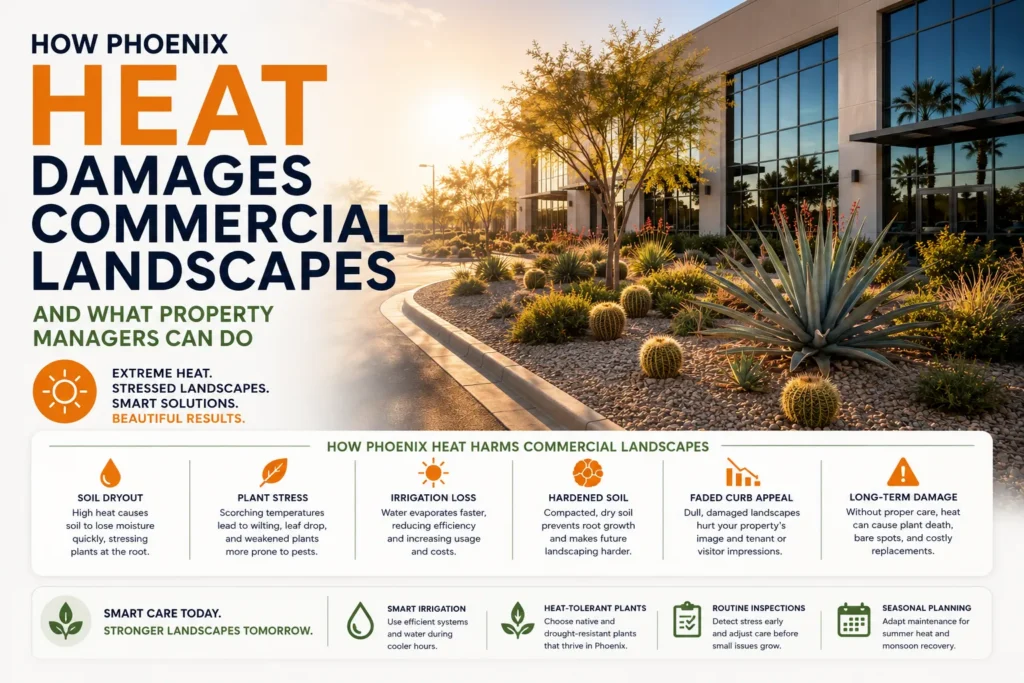
Phoenix heat can damage a commercial landscape much faster than many property managers expect. That risk becomes clear once summer conditions begin to build.
A landscape may look healthy at the start of summer and begin showing dry turf, stressed shrubs, failing irrigation zones, brittle plants, and declining common areas within a few weeks. Once visible damage appears, the property may already be facing plant replacement, turf recovery, irrigation repair, and additional water costs.
Commercial landscapes are especially vulnerable because they often cover large areas, rely on multiple irrigation zones, and include a mix of turf, trees, palms, shrubs, decorative rock, decomposed granite, and high-traffic common spaces.
The goal is not simply to react when the landscape turns brown.
The goal is to identify early signs of heat stress, monitor the right areas, and take action before problems become costly.
This guide explains how Phoenix heat damages commercial landscapes and what property managers can do to protect the appearance of their property, safety, and long-term maintenance budgets.
Why Phoenix Heat Creates Serious Landscape Problems
Phoenix landscapes face extreme summer conditions that create serious landscape problems.
High temperatures, intense sunlight, dry air, hot soil, reflected heat from pavement, and limited natural rainfall place constant pressure on plants and irrigation systems.
Commercial properties also create their own heat zones.
Parking lots, sidewalks, walls, rooftops, decorative rock, and concrete surfaces absorb heat during the day and continue releasing it after sunset. Plants located near these surfaces often experience much higher temperatures than plants in shaded or open areas.
This creates uneven landscape stress across the same property.
A shrub near a parking lot may decline while the same plant survives near a shaded courtyard. Turf next to a south-facing wall may dry faster than turf near a tree canopy. Irrigation lines under exposed rock may also experience more wear.
Property managers should never assume that the entire landscape responds to summer heat in the same way.
Turf Can Decline Quickly During Extreme Heat
Turf is often one of the first areas to show signs of commercial landscape heat stress, and its decline can reveal larger issues on the property.
Common signs include thinning grass, brown patches, faded color, dry edges, compacted areas, and uneven growth.
Heat alone is not always the only cause.
Turf decline often results from a combination of heat, irrigation problems, poor coverage, soil compaction, heavy foot traffic, or improper mowing practices.
On apartment communities and HOA properties, turf near walking paths, pet areas, playgrounds, pools, and gathering spaces may decline faster because it receives both heat exposure and repeated use.
Property managers should pay attention to patterns.
A dry patch in a single isolated area may indicate a blocked sprinkler head or a coverage issue. Widespread fading may indicate irrigation scheduling problems, soil conditions, or broader summer stress.
Waiting too long can turn a manageable turf issue into full replacement work. Address turf problems quickly to limit damage and avoid larger repair costs.
Shrubs and Ground Cover Show Stress Through Color and Growth
Shrubs and ground cover often reveal heat damage through changes in leaf color, growth, and density.
Property managers may notice yellowing, curling leaves, burned edges, thinning branches, leaf drop, or plants that appear weak compared with surrounding areas.
Some shrubs may still look alive even as they experience serious root stress.
This is common when plants receive shallow watering that wets the surface but does not reach the full root zone.
Plants near walls, parking lots, monument signs, and decorative rock areas are especially vulnerable because reflected heat increases moisture loss.
Routine trimming can also make heat stress worse if plants are cut too aggressively during the hottest part of the year.
A strong summer landscape maintenance plan should balance appearance with plant protection. Review care practices regularly and adjust them to protect plants during peak heat.
Trees and Palms Face Heat and Structural Stress
Mature trees usually tolerate heat better than smaller plants, but they can still experience serious summer stress.
Signs may include leaf scorch, thinning canopy, early leaf drop, dead branches, and reduced growth.
Trees that are already weakened by poor irrigation, root damage, disease, or improper trimming are more likely to decline during extreme heat.
Palms can also show stress through browning fronds, slow growth, weak appearance, or excessive debris.
Property managers should remember that tree stress is not only an appearance issue.
Weak limbs, dead branches, and declining trees can become safety concerns, especially before monsoon storms.
Summer inspections should include both plant health and structural condition. Check for stress and safety concerns so problems can be corrected before storms.
Irrigation Systems Work Harder and Fail Faster in Summer
Irrigation systems become even more important during Phoenix summers.
At the same time, they are under more pressure.
Longer run times, increased watering demand, aging parts, soil movement, broken emitters, clogged nozzles, valve failures, and controller problems can all affect water delivery.
A small irrigation problem that might go unnoticed in winter can cause visible landscape damage quickly in July or August.
Property managers should watch for dry zones, standing water, broken sprinkler heads, uneven spray patterns, overspray, soft ground, and unusual water use.
The irrigation controller should also be reviewed as temperatures change.
A schedule that worked in spring may not support the property during peak summer heat. At the same time, simply increasing run times without checking the system can create waste, runoff, and overwatering.
The goal is efficient delivery, not just more water. Verify coverage and adjust irrigation carefully so water is used effectively.
Decorative Rock Can Increase Plant Stress
Decorative rock is common across Phoenix commercial landscapes.
It is durable, clean-looking, and well-suited to desert properties, but it also absorbs and holds heat.
During the summer, rocky areas can become significantly hotter than the surrounding soil.
Plants placed in dense rock beds may experience additional heat around their root zones, especially when they are young, poorly established, or planted close to reflective walls.
Decorative rock can also hide irrigation problems.
A leaking drip line may go unnoticed under rock. An emitter may become buried, blocked, or moved away from the plant. Water may run beneath the surface without reaching the intended root zone.
Property managers should inspect rocky areas carefully rather than assuming that dry landscaping requires little attention.
Decomposed Granite Can Shift, Dry Out, and Erode
Decomposed granite is widely used in Phoenix commercial properties, walking paths, common areas, and low-water landscapes.
Extreme heat can dry the surface, increase dust, and make loose material more likely to shift under foot traffic, irrigation runoff, or storm activity.
During monsoon season, areas that have become dry and unstable may wash out more easily.
Property managers should monitor for erosion, low spots, exposed irrigation lines, uneven walking surfaces, and material collecting along curbs or drains.
Decomposed granite should look even, stable, and controlled.
Repeated washout or movement may indicate drainage or irrigation problems that require correction.
Common Areas Can Lose Their Appearance Fast
Commercial common areas receive more use and more visual attention than many other parts of a property.
These may include entrances, courtyards, pool areas, mailbox stations, outdoor seating, dog areas, walking paths, and monument signs.
Heat damage in these areas affects how residents, tenants, customers, and visitors assess the property as a whole.
A few dead shrubs near an entrance can make the property feel neglected. Dry turf near a leasing office can affect first impressions. Broken irrigation near a walkway can create both appearance and safety concerns.
Property managers should give high-visibility common areas more frequent attention during summer.
These locations should require faster response times, more detailed irrigation checks, and earlier plant replacement decisions than low-visibility areas.
Reflected Heat Creates Hidden Damage Zones
Some of the most damaged parts of a commercial landscape are located near heat-reflecting surfaces.
South and west-facing walls, glass buildings, parking lots, concrete walkways, loading areas, and metal structures can create intense localized heat.
Plants in these areas may receive much more heat than the weather report suggests.
This is why property managers often see one section of the landscape decline while the rest remains stable.
These zones should be monitored separately. Check them closely and respond quickly when conditions begin to change.
In some cases, the long-term solution may involve changing plant selection, improving irrigation coverage, adding shade, adjusting rock placement, or redesigning the area with materials better suited to extreme exposure.
Overwatering Can Be Just as Damaging as Underwatering
When plants begin looking stressed, the first reaction is often to increase watering.
That can create a different problem.
Too much water can weaken roots, create disease conditions, cause standing water, increase runoff, and damage plants that prefer drier soil.
Heat-stressed plants do not always need more water.
They may need better timing, deeper watering, improved coverage, or irrigation repair.
Property managers should avoid making major changes to watering without understanding the cause of the problem.
A professional irrigation inspection can help determine whether the landscape is receiving too little, too much, or uneven water.
What Property Managers Should Monitor During Summer
Property managers do not need to diagnose every plant or irrigation issue themselves.
They do need a consistent inspection routine.
During Phoenix summer, property walks should focus on turf color, dry patches, wilting plants, burned leaves, dead branches, uneven irrigation, standing water, damaged sprinkler heads, exposed drip lines, erosion, rock movement, and areas near heat-reflecting surfaces.
Water bills should also be reviewed for unusual increases.
The most important question is whether the landscape is changing.
If one area looks weaker each week, the issue should be investigated before the damage spreads.
Why Early Action Saves Money
Heat damage is usually less expensive to correct when it is caught early.
A blocked emitter may require a small repair.
If ignored, it may lead to multiple dead shrubs and replacement labor.
A broken sprinkler head may be inexpensive to fix.
If left unresolved, it may create turf loss, runoff, and higher water bills.
A stressed tree may need irrigation adjustment or pruning.
If neglected, it may become a larger safety and replacement issue.
Property managers who act early usually protect both the landscape and the maintenance budget.
How a Commercial Landscaping Company Should Respond to Summer Heat
A Phoenix commercial landscaping company should not use the same maintenance approach all year.
Summer service should include closer attention to irrigation, plant stress, turf condition, high-visibility areas, and tree health.
The landscaping team should communicate problems early, explain likely causes, and recommend practical next steps.
Property managers should expect the vendor to identify concerns such as dry zones, leaking irrigation, heat-damaged plants, unsafe branches, declining turf, and areas that may need redesign.
Clear communication is especially important because some summer damage cannot be solved through routine maintenance alone.
A property may need irrigation repair, plant replacement, soil improvement, tree work, or a larger landscape upgrade.
When Landscape Replacement Becomes Necessary
Not every heat-damaged plant can be recovered.
Some plants may be too stressed, poorly located, or unsuited for the exposure they receive.
Replacement may be necessary when plants are dead, structurally weak, repeatedly failing, or creating an ongoing maintenance problem.
However, replacement should not happen without fixing the underlying cause.
Installing new plants in the same location with the same irrigation problem usually results in repeated failures.
Before replacing turf, shrubs, or trees, property managers should review irrigation coverage, soil condition, heat exposure, drainage, and plant suitability.
This increases the likelihood of long-term success.
Building a Better Summer Landscape Plan
A strong summer landscape plan should begin before the hottest part of the year.
Property managers should review irrigation performance, identify high-risk areas, check tree condition, inspect common spaces, and confirm how urgent issues will be reported and repaired.
The plan should also identify which areas matter most to residents, tenants, customers, and visitors.
Not every landscape zone has the same priority.
Entrances, monument signs, leasing areas, pool spaces, walkways, and high-traffic common areas often require more attention.
Planning ahead allows the property to move through summer with fewer emergencies and fewer visible failures.
Final Thoughts
Phoenix heat can quickly damage commercial landscapes, especially when irrigation problems, poor plant placement, reflected heat, and delayed maintenance are present.
Turf, shrubs, trees, palms, decorative rock areas, decomposed granite, and common spaces all respond differently to extreme summer conditions.
For property managers, the most important step is early observation.
Dry spots, plant stress, uneven watering, erosion, standing water, dead branches, and declining high-visibility areas should never be ignored.
A proactive summer landscape maintenance plan helps protect curb appeal, control replacement costs, reduce water waste, and keep the property looking professionally managed.
In Phoenix, summer damage is not always avoidable.
Expensive summer damage often is.
Frequently Asked Questions
Phoenix heat can dry turf, stress shrubs, weaken trees, increase irrigation demand, damage root zones, and accelerate landscape decline.
Common signs include brown turf, wilting plants, burned leaves, thinning shrubs, dry soil, dead branches, and uneven landscape color.
High-visibility commercial landscapes should be inspected regularly throughout summer, with particular attention to irrigation, turf, trees, and stressed plants.
Yes. Decorative rock absorbs and retains heat, which can increase stress on plants and in root zones.
Property managers should check irrigation coverage, watering schedules, soil condition, reflected heat, and plant placement before increasing water or replacing plants.