
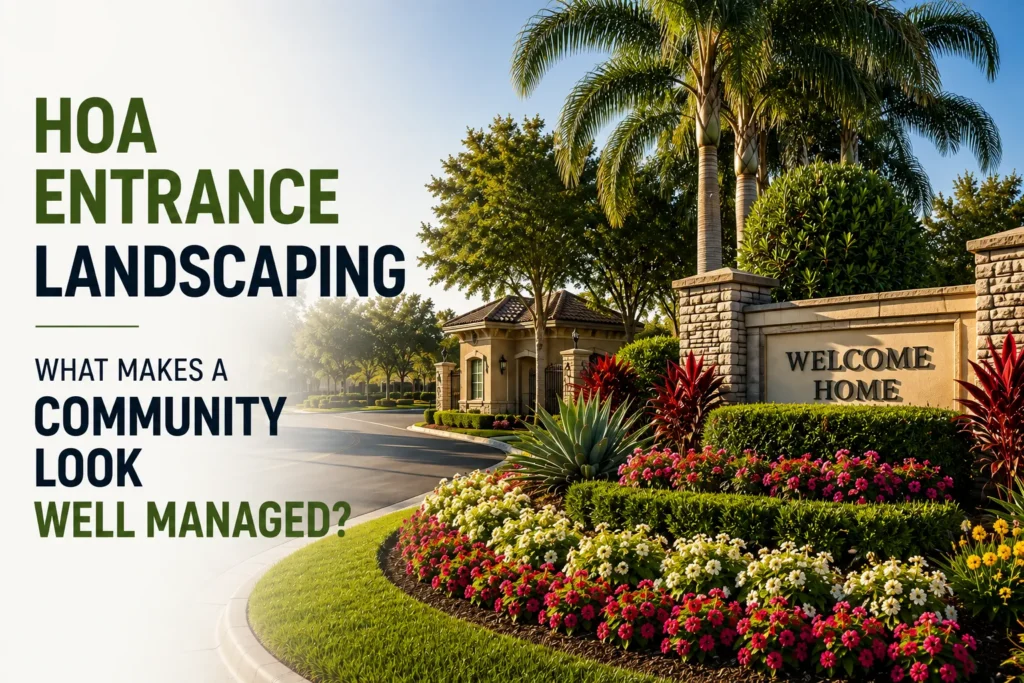
An HOA entrance tells residents and visitors a lot about the community before they see anything else.
A clean monument sign, healthy plants, fresh decorative rock, controlled weeds, working irrigation, and well-maintained common areas create the impression that someone is paying attention.
The opposite is just as noticeable.
A few dead shrubs, faded rock, exposed irrigation tubing, weeds around the monument, or plants covering the community sign can make an otherwise attractive neighborhood feel neglected.
For HOA boards and community managers, the entrance deserves more attention than almost any other landscape area because it carries more visual weight than its size suggests.
It is where residents come home every day. It is where prospective buyers form an early opinion of the neighborhood. It is where real estate agents, delivery drivers, contractors, guests, and future homeowners first experience the community.
Good HOA landscaping does not need to be complicated or expensive.
It needs to look intentional, healthy, clean, and consistently maintained.
This guide explains the landscaping details that make an HOA entrance look well managed and where boards should focus when the entrance needs improvement.
The Entrance Should Look Intentional, Not Simply Maintained
There is an important difference between a landscape that has been serviced and one that looks well managed.
A crew can trim shrubs, blow sidewalks, and remove weeds without creating a strong entrance.
Well-managed HOA entrance landscaping has visual order.
Plants frame the monument instead of hiding it. Decorative rock remains inside the beds. Irrigation reaches the plants without spraying onto the road. Dead material is replaced before it becomes a permanent part of the landscape. Trees do not overwhelm signs or lighting.
Each part of the entrance should look like it belongs there.
Boards do not necessarily need more plants, more flowers, or more landscape features. In many cases, simplifying an aging entrance creates a cleaner result than continuing to add material.
The goal should be a landscape that looks deliberate every time someone enters the community.
Start With the Monument Sign
The monument sign is usually the visual anchor of an HOA entrance.
Landscaping should support it rather than compete with it.
One of the most common problems at older communities is plant material that has outgrown the original design. Shrubs that looked appropriate when installed may eventually cover lettering, lighting, address numbers, or decorative features.
Trees can create the same issue when branches begin blocking visibility from the road.
A well-maintained monument area should keep the community name easy to see from the intended approach.
Plants should frame the monument without growing across it. Weeds and debris should not collect around the base. Decorative rock should look even rather than washed out or scattered.
Boards should also look at the monument at night.
Plants that appear fine during the day may block landscape lighting after dark. A simple pruning adjustment or selective plant replacement can often improve nighttime presentation without changing the monument itself.
Decorative Rock Has a Bigger Impact Than Most Boards Realize
Decorative rock covers large areas in many Phoenix HOA entrances.
Because there is so much of it, its condition strongly affects how clean the entrance looks.
Over time, rock can fade, thin out, move into curbs, collect leaves, expose bare soil, and become mixed with different materials after repeated repairs.
None of these problems may seem serious individually.
Together, they make the entrance look tired.
Boards do not always need to replace all decorative rock. Often, the existing material can be redistributed, cleaned up, and supplemented in thin areas.
Edges should remain clearly defined so rock does not continually spill into sidewalks, gutters, or drive lanes.
Before adding new rock, the landscaping company should also check what is happening underneath it.
Decorative rock can hide damaged drip lines, water leaks, erosion, and exposed tubing. Covering those problems with additional material only makes them harder to find later.
Plant Health Matters More Than Plant Quantity
An entrance with fewer healthy plants usually looks better than one filled with struggling vegetation.
Dead shrubs, heat-damaged plants, empty spaces, overgrown growth, and repeated plant failure are common signs that an HOA entrance needs attention.
Boards should not automatically replace every dead plant with the same species.
The better question is why the plant failed.
Was irrigation reaching the root zone?
Was the plant exposed to reflected afternoon heat from a wall or roadway?
Did it outgrow the available space?
Was drainage poor?
Was it simply a poor plant choice for that location?
Understanding the cause matters because replacing a plant without fixing the underlying problem often leads to another replacement a few months later.
Phoenix HOA entrances frequently deal with intense sun and reflected heat from pavement, masonry, stone, and monument structures.
Plant selection should account for those conditions.
The goal is not to create the most elaborate planting plan. It is to use plants that can remain attractive in the actual environment surrounding the entrance.
Replace Weak Plants Before the Entrance Looks Neglected
One dying shrub may not seem urgent.
Several dying shrubs quickly change how the community feels.
Boards often delay plant replacement because each plant appears to be a small issue. Eventually, enough weak or empty areas accumulate that the entrance begins looking neglected.
A better approach is to review the entrance periodically and identify plant material that is clearly declining, no longer appropriate, or repeatedly creating maintenance problems.
Selective replacement can refresh the entrance without requiring a full landscape renovation.
High-visibility plants near the monument, entry corners, and pedestrian areas should receive priority because they influence the overall appearance more than plants located deeper inside the community.
Irrigation Coverage Can Make or Break the Entrance
A beautiful HOA entrance cannot stay attractive without reliable irrigation.
This is especially true in Phoenix.
Entrance landscaping often includes several plant types within a relatively small area. Shrubs, trees, seasonal color, accent plants, and ground cover may all have different watering needs.
Problems begin when one irrigation setup is expected to serve everything equally.
Boards and community managers should watch for dry pockets, constantly wet areas, dead plants in the same location, exposed drip tubing, standing water, overspray, and unusual plant stress.
Repeated plant loss in one portion of the entrance is often an irrigation clue.
Water should be reaching the plants rather than the monument, sidewalk, curb, or street.
Irrigation systems also need adjustment as plants mature. An emitter placed correctly when a plant was installed may no longer be positioned properly years later.
Routine irrigation checks protect the appearance of the entrance and help prevent unnecessary plant replacement.
Seasonal Color Works Best When It Has a Purpose
Seasonal color can make an HOA entrance feel more welcoming, but more color is not automatically better.
Flowers work best when they are concentrated around important visual points such as the monument sign or a clearly defined entrance bed.
Large flower areas can become expensive to replace and maintain. They also look worse than permanent landscaping when irrigation fails, or seasonal plants begin declining.
For many communities, smaller areas of healthy seasonal color create a stronger impression than large beds that are difficult to keep consistent.
Boards should also consider whether seasonal color fits the community’s overall landscape style.
A desert-focused entrance may benefit more from healthy permanent accent plants and clean rock than from frequent flower rotations.
The important standard is consistency.
If seasonal color is used, it should look intentional and healthy rather than becoming another maintenance problem.
Weed Control Is Part of the First Impression
Residents often notice weeds at the entrance before they notice them elsewhere in the community.
Weeds commonly appear around monument bases, curb lines, decorative rock, sidewalks, utility boxes, and irrigation equipment.
Because the entrance receives so much attention, visible weeds can quickly create complaints.
Weed control should therefore be proactive.
The goal is not to wait until growth becomes obvious and then perform a large cleanup. Regular maintenance should keep weeds from dominating high-visibility beds in the first place.
Recurring weed problems may also reveal irrigation runoff, soil disturbance, thin rock coverage, or other conditions that should be corrected rather than repeatedly treated.
Common Areas Immediately Behind the Entrance Matter Too
The entrance experience does not end at the monument sign.
Residents often move directly from the entry drive into landscaped common areas, greenbelts, sidewalks, walls, or community amenities.
If the monument looks excellent but the next fifty yards contain dead plants, weeds, dry turf, or scattered debris, the positive first impression disappears quickly.
HOA boards should look at the entrance as a short visual sequence rather than a single flower bed.
The monument area, median, nearby walls, entry road, common turf, adjacent trees, and first visible landscape beds should feel like part of the same maintenance standard.
This is especially important in communities where the entrance opens directly into a park, clubhouse, pool, or central common area.
Clean Bed Edges Make an Entrance Look More Finished
Small details often separate a maintained landscape from a polished one.
Bed edges are a good example.
Decorative rock drifting into pavement, turf growing into beds, uneven transitions, and poorly defined planting areas create visual clutter.
Restoring clean edges gives the entrance sharper lines without requiring new plants or expensive materials.
This is one of the simplest landscape improvements an HOA can make.
Clean edges are particularly noticeable around monument signs, sidewalks, medians, and turf areas because these locations already have strong visual boundaries.
Trees Should Frame the Entrance Without Taking It Over
Mature trees add character and shade, but they can also overwhelm an entrance when they are not managed properly.
Branches may cover monument signs, interfere with lighting, reduce visibility at intersections, or hang too low over pedestrian and vehicle areas.
Trees near entrances should be evaluated for both appearance and safety.
The objective is not aggressive trimming.
It is maintaining appropriate clearance while preserving a healthy tree structure.
Phoenix HOA boards should also consider monsoon exposure. Weak, damaged, or poorly maintained branches near entry roads and sidewalks can become a larger concern during summer storms.
Tree management should therefore be part of entrance planning rather than something addressed only after a branch falls.
Palm Maintenance Should Match the Visibility of the Entrance
Palm trees are common features at Phoenix community entrances.
When healthy and properly maintained, they can create a strong sense of arrival.
When neglected, dead fronds and hanging debris become highly visible.
Palm maintenance should be planned rather than handled only after the appearance declines.
Boards should understand whether palm trimming is included in the regular landscaping agreement or quoted separately.
Many maintenance contracts handle routine landscape care but treat palm and major tree work as specialized services.
Knowing that distinction helps the board budget before palm maintenance becomes urgent.
Irrigation Overspray Can Make an Entrance Look Poorly Managed
Water repeatedly spraying onto roads, sidewalks, monument walls, or signs creates a subtle but important negative impression.
It can leave mineral stains, create slippery areas, waste water, and reduce irrigation coverage where the water is actually needed.
Overspray may come from a tilted sprinkler head, incorrect nozzle, high pressure, poor system placement, or a head that has moved over time.
At an HOA entrance, these problems should be corrected quickly.
Residents pass through the area every day, making recurring water waste much more visible than it might be in a less traveled section of the community.
Lighting and Landscaping Need to Work Together
A well-landscaped entrance should also look good after sunset.
Plants can interfere with monument lighting, pathway lights, uplighting, and security lighting as they grow.
Boards should periodically inspect the entrance at night to see whether shrubs or tree branches are creating shadows or covering fixtures.
Sometimes the solution is simple pruning.
In other cases, a plant has outgrown the location and replacement makes more sense.
Landscape maintenance and lighting should complement each other so the entrance remains readable and inviting throughout the evening.
Cleanliness Is Part of Landscaping
A landscape can have healthy plants and still look poorly managed if debris is scattered around the entrance.
Palm material, fallen branches, windblown trash, leaves, weeds, and landscape clippings should not remain in high-visibility areas.
Phoenix wind and monsoon conditions make entrance cleanup particularly important.
Because the entrance sits close to streets and vehicle traffic, debris can collect quickly even when the rest of the property remains relatively clean.
Routine service should include enough cleanup to restore the entrance after landscape work rather than leaving clippings or loose material behind.
How HOA Boards Can Decide What to Upgrade First
Not every entrance needs a complete redesign.
Many communities can create a major visual improvement through a few focused upgrades.
Boards should first address anything that looks dead, unsafe, broken, or obviously neglected.
Irrigation problems come first because new plants will not survive without reliable water.
Next, focus on the monument area, entrance beds, decorative rock, plant replacement, weed control, edging, and high-visibility common areas.
Seasonal color and additional enhancements can follow once the foundation is working properly.
This order prevents the HOA from spending money on cosmetic upgrades while underlying maintenance problems remain unresolved.
Avoid the Cycle of Constant Small Repairs
Some HOA entrances slowly decline because boards approve one isolated repair at a time without looking at the area as a whole.
One plant gets replaced.
Then another irrigation line breaks.
Several months later, new rock is added.
A year later, overgrown shrubs are removed.
Each decision may be reasonable, but the entrance never develops a consistent appearance.
When recurring problems begin accumulating, boards should consider a targeted landscape improvement plan.
This does not mean a complete redesign.
It means evaluating the monument, plants, irrigation, rock, trees, lighting visibility, and maintenance needs together so improvements support one another.
Communication With the Landscaping Vendor Matters
HOA boards should not have to discover every entrance problem themselves.
A commercial landscaping company familiar with HOA maintenance should be watching high-visibility areas and communicating concerns before they become resident complaints.
The vendor should report failing plants, irrigation problems, tree concerns, recurring weeds, damaged rock areas, and improvement opportunities.
Boards should also be able to distinguish routine maintenance from upgrades that require separate approval.
Clear communication allows community managers to plan work, explain decisions to residents, and budget for improvements instead of reacting after the entrance deteriorates.
What a Well-Managed HOA Entrance Should Communicate
A strong community entrance does not need to look expensive.
It needs to communicate care.
Residents should see healthy plants, controlled growth, clean beds, readable signage, stable decorative rock, working irrigation, maintained trees, and an overall landscape that feels consistent.
Nothing should appear forgotten.
That is what makes an entrance feel professionally managed.
For HOA boards, this standard is useful because it moves the conversation away from subjective preferences about individual plants or colors.
The question becomes simpler:
Does the entrance look healthy, clean, safe, intentional, and maintained?
If the answer is yes, the landscape is doing its job.
Final Thoughts
HOA entrance landscaping plays an outsized role in how residents, visitors, and prospective buyers perceive a community.
A well-managed entrance combines a visible monument sign, healthy plant material, clean decorative rock, reliable irrigation, controlled weeds, appropriate seasonal color, maintained trees and palms, and strong presentation throughout the surrounding common areas.
The best improvements are not always the biggest.
Sometimes replacing a few failing plants, correcting irrigation coverage, cleaning the beds, refreshing rock, and restoring clear sight lines can completely change the way a community entrance feels.
For HOA boards and community managers in Phoenix, the goal should be consistency rather than complexity.
When the entrance looks intentional every day, residents are much more likely to feel that the community itself is being well managed.
Frequently Asked Questions
HOA entrance landscaping should include healthy plants, a visible monument sign, clean decorative rock, weed control, reliable irrigation, maintained trees, and clear bed edges.
Boards can improve an entrance by replacing failing plants, repairing irrigation, refreshing decorative rock, cleaning beds, improving edging, and addressing monument visibility.
Irrigation is essential in Phoenix because entrance plants can decline quickly when coverage is poor, emitters fail, or watering is uneven.
No. Plants should frame the monument and support its appearance without covering the community name, address, lighting, or important signage.
No. Seasonal color can add visual interest, but healthy permanent landscaping and consistent maintenance are more important than maintaining large flower beds.