
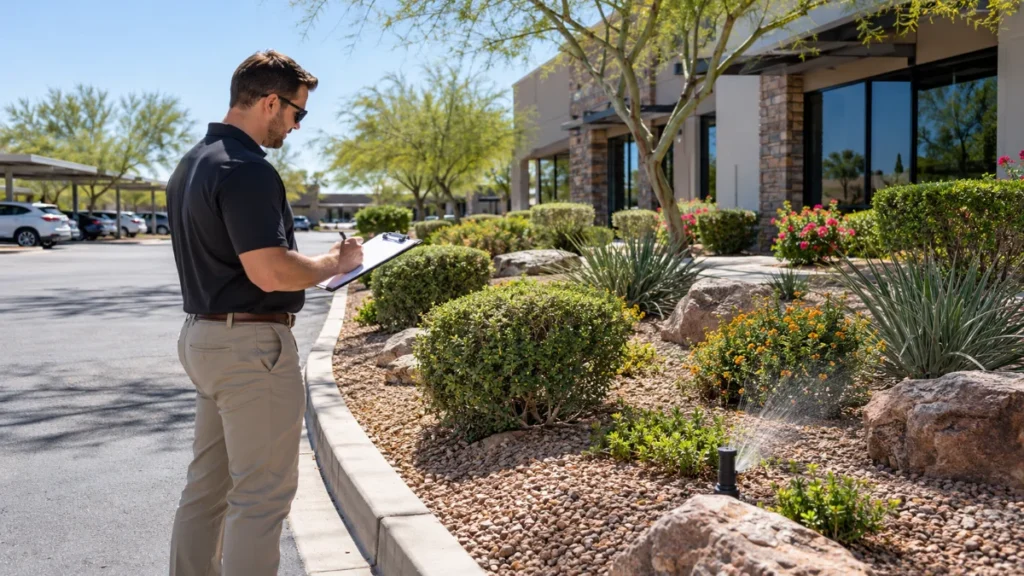
A landscaping company can show up every week and still underperform.
For property managers, the difficult part is separating activity from results. A crew may be on site, but weeds keep returning in the same beds. Shrubs may be trimmed, but they lose their natural shape. Irrigation problems may be obvious from dry spots or runoff, yet no one reports them. Requests may be acknowledged but not actually closed.
That is why commercial landscape maintenance should be measured against clear service standards instead of impressions alone.
A practical vendor scorecard gives property managers a repeatable way to evaluate what is being completed, how the property looks, how quickly problems are resolved, and whether the landscaping company is helping prevent issues rather than simply reacting to complaints.
This guide explains what to measure, how to score performance fairly, and which patterns indicate that a commercial landscaping vendor needs correction, a stronger service plan, or replacement.
Start With the Contract, Not Personal Preference
Before scoring a vendor, compare performance with the actual scope of work.
A landscape maintenance contract should define visit frequency, routine tasks, irrigation responsibilities, cleanup expectations, pruning, weed control, reporting, and any services billed separately. If major tree trimming or irrigation repair is excluded, the vendor should not be scored poorly simply because those projects have not been completed under the base contract.
The scorecard should measure whether the company is doing what it agreed to do and whether it communicates clearly when something falls outside that scope.
This distinction makes the evaluation more objective and more useful when discussing performance with ownership, an HOA board, an asset manager, or the landscaping company itself.
Score Service Completion, Not Just Crew Attendance
The first question is whether the crew consistently completes scheduled work.
A crew arriving on site is not the same as the property receiving a complete service visit.
Property managers should look for evidence that the full property was addressed. Turf areas should be maintained where applicable. Bed areas should be checked. Debris should be removed. Complete routine trimming at the proper time. Hardscape should be left clean after service.
Repeatedly missed corners, skipped beds, or incomplete cleanup suggest the issue isn’t occasional oversight but inconsistent service.
The best measure is whether the property looks complete after the crew leaves.
Measure Weed Control by Recurrence
Commercial property won’t stay completely weed-free every day of the year. Wind, irrigation, disturbed soil, monsoon moisture, and seasonal growth all create new weed pressure.
What matters is whether weeds are being controlled before they become a visible property problem.
A strong vendor should not need repeated reminders about the same curb line, monument bed, parking island, or common area. If weeds reappear in the same locations and remain visible across multiple service cycles, the problem may be inadequate treatment, poor follow-through, or an underlying irrigation or landscape condition that has not been addressed.
Property managers should score both visible weed levels and how quickly they correct recurring problem areas.
Look at Pruning Quality, Not Only Whether Plants Were Cut
Pruning can make a property look cleaner or make healthy plants look worse.
Maintain commercial shrubs for visibility, clearance, plant health, and the intended landscape appearance. Plants should not automatically be cut into the same shape or heavily reduced just because a crew is present.
Poor pruning often shows up as bare interiors, repeated shearing, blocked flowering, plants cut too low, shrubs still blocking signs or walkways, or plants being forced into spaces they have outgrown.
A good score asks whether pruning improved the property while respecting the plant and the area’s purpose.
Irrigation Reporting Should Be a Core Performance Measure
In Phoenix, irrigation observation is one of the most valuable things a landscape maintenance company can provide.
The maintenance crew is on the property regularly. That gives them an opportunity to notice dry zones, leaks, broken sprinkler heads, damaged drip lines, overspray, valve problems, standing water, and plant stress before the property manager receives a complaint.
Not every irrigation repair needs to be included in the maintenance contract. Reporting should still be expected.
A vendor that repeatedly services a property without identifying obvious irrigation problems is leaving an important part of the landscape unmanaged.
The score should reflect whether the vendor notices irrigation concerns, documents them, communicates them, and follows through to resolution.
Response Time Should Measure Closure, Not Just the First Reply
Fast communication matters, but a quick email saying “received” is not the same as solving the issue.
Property managers should measure two things: how quickly the vendor responds and how quickly the concern reaches a clear outcome.
A simple issue may be corrected during the next visit. An irrigation repair may require approval. A larger landscape improvement may need a separate proposal. In every case, the manager should know what is happening and what the next step is.
The strongest vendors close the communication loop.
Repeated reminders, unclear ownership, and open issues that disappear into email threads should lower the performance score even when the company replies quickly at first.
Use Property Appearance as a Result Metric
The property should look consistently managed between service visits, not just for a few hours after the crew leaves.
Evaluate entrances, monument signs, leasing offices, common areas, parking islands, walkways, turf, beds, and other high-visibility zones from the perspective of a resident, tenant, customer, or visitor.
Look for visual patterns rather than isolated imperfections.
If decorative rock is constantly displaced, shrubs remain uneven, dead material sits in beds, turf edges look unfinished, or high-visibility areas repeatedly decline, the maintenance program isn’t producing consistent results.
A commercial landscaping company should be judged partly by the condition it leaves behind.
Recommendations Show Whether the Vendor Is Managing or Merely Servicing
A strong commercial landscape vendor should occasionally recommend improvements.
That does not mean sending constant sales proposals.
It means identifying conditions that routine maintenance alone cannot solve. Examples include an aging irrigation zone, a repeatedly failing plant area, trees approaching a clearance problem, thinning decorative rock, or a bed that needs renovation because the original plant material no longer fits.
A vendor that never recommends anything may be overlooking problems. A vendor that recommends everything may be overselling.
Useful recommendations are specific, prioritized, and connected to an observed property need.
Recurring Unresolved Issues Are the Strongest Warning Sign
Every commercial property will have landscape issues.
The most important performance question is whether the same problems continue coming back without explanation or resolution.
A recurring leak, dry area, weed problem, dead plant zone, visibility conflict, or resident complaint should create a clear next step.
If the same concern appears month after month, the property manager should ask why.
The cause may be outside the base maintenance scope, but the vendor should still identify that limitation and recommend a solution. Repetition without progress is a performance problem even when individual service visits appear acceptable.
A Practical Commercial Landscaping Vendor Scorecard
Commercial Landscaping Vendor Scorecard
Use a five-point scale. A score of five represents strong, proactive performance. A score of three is acceptable but may need improvement. A score of one indicates a recurring performance problem.
| Category | 5 Excellent | 3 Acceptable | 1 Poor |
| Service completion | Full scope completed consistently with no recurring skipped areas | Minor misses corrected without repeated reminders | Repeated incomplete visits or skipped areas |
| Weed control | Weeds stay controlled, and recurring areas are addressed proactively | Occasional visible weeds corrected in normal service | Same visible weed problems continue across visits |
| Pruning quality | Plants maintain healthy form, visibility and clearance | Generally acceptable with occasional uneven work | Overcut, misshapen, or obstructive plants remain common |
| Irrigation reporting | Problems are identified early, documented and followed through | Obvious problems are usually reported when found | Leaks, dry zones or overspray go unreported |
| Response and closure | Replies are prompt, and issues reach a clear outcome | Normal requests are handled within a reasonable period | Repeated follow-ups are needed to get action |
| Property appearance | Property looks consistently maintained between visits | Overall acceptable with a few recurring weak areas | Property often looks unfinished or neglected |
| Recommendations | Specific, prioritized ideas are raised when needed | Recommendations are occasional but useful | No proactive guidance or constant irrelevant upselling |
| Recurring issues | Root causes are identified, and problems stop repeating | Some issues take time, but progress is visible | Same complaints remain unresolved month after month |
How to Use the Scorecard
Score each category from one to five once per month or once per quarter depending on the size and complexity of the property.
The total score matters less than the pattern.
A vendor may have an excellent month after a major cleanup and then gradually decline. Another may score consistently well but have one weak category, such as irrigation reporting, that can be corrected with clearer expectations.
The scorecard is most useful when the property manager records short notes beside lower scores. “Parking island weeds still visible after two visits” is more actionable than “weed control poor.”
This gives the landscaping company a fair opportunity to correct the problem and gives management a record if the concern continues.
Separate Maintenance Performance From Capital Needs
An aging landscape can make a good maintenance company appear worse than it is.
Thin decorative rock, outdated irrigation, mature shrubs that have outgrown their spaces, declining plant material, and old beds may not be fixable through normal weekly service.
Before lowering a vendor score, determine whether the problem is execution or infrastructure.
If the crew is maintaining an old shrub correctly but the shrub no longer fits the entrance, that is a landscape improvement issue. If an irrigation mainline repeatedly fails, the property may need repair or replacement rather than additional maintenance visits.
A strong vendor should help make this distinction clear.
Review High Visibility Areas Separately
Not every part of a commercial property matters equally.
An entrance, leasing office, pool area, monument sign, medical building entrance, or retail frontage may require a higher standard than a remote perimeter bed.
The vendor scorecard can include a separate note for high-visibility areas so those locations don’t get lost in an overall property rating.
If the entrance repeatedly looks poor while the back of the property looks excellent, the average score may hide the problem that matters most to residents or customers.
Check Whether Crew Quality Is Consistent
Some vendors perform well when a particular crew leader is present and poorly when staffing changes.
Property managers should watch for sudden differences in pruning, cleanup, irrigation reporting, or missed work after crew changes.
A commercial landscape company should have enough property documentation and supervision that service standards don’t disappear when an employee is absent.
Consistency across crews is part of vendor performance.
Track Complaints, But Do Not Let Complaints Become the Only Metric
Resident and tenant complaints are useful signals, but they are not a complete performance system.
Some complaints are subjective. Others reveal real problems that the manager would not have noticed quickly.
Track the type of complaint, where it occurred, whether it was valid, and how the vendor responded.
If the same issue generates multiple complaints, it deserves more weight. If complaints fall after the vendor corrects a recurring problem, that is evidence of improvement.
The goal is to use complaints as data rather than managing the landscape only through whoever emails most often.
Expect Documentation on Larger or More Complex Properties
For a small commercial site, a short email may be enough.
For a large HOA, apartment community, office campus, or multi-building property, stronger documentation is valuable.
Photos, irrigation notes, improvement recommendations, completion updates, and records of unresolved items help property managers coordinate with boards, ownership groups, and maintenance teams.
The reporting process should match the property’s complexity without creating unnecessary paperwork.
Know When a Low Score Means the Contract Needs to Change
Poor performance is not always caused by a poor contractor.
Sometimes the service scope is too limited for the condition of the property.
If a high-traffic apartment community is being serviced too infrequently, increasing expectations without changing frequency may not work. If irrigation monitoring is not included, the contract may need to be expanded. If years of deferred improvements have created failing beds and outdated plant material, routine maintenance alone cannot restore the property.
Before changing vendors, determine whether the current contract gives any vendor a realistic chance to meet the expected standard.
Know When It Is Time to Address the Vendor Directly
One low score should usually trigger a conversation, not an immediate termination.
Bring specific examples, explain the expected standard, agree on corrective steps, and set a reasonable review point.
The conversation becomes more productive when the manager can say, “The same three irrigation issues were reported in March and remain unresolved,” instead of, “The landscaping does not feel good lately.”
Objective performance measures make accountability easier for both sides.
When It May Be Time to Consider a Different Landscaping Company
A vendor change becomes reasonable when service remains inconsistent after expectations are clear, communication repeatedly breaks down, obvious irrigation or safety concerns are ignored, and the same unresolved issues continue despite documented follow-up.
The decision should be based on a pattern, not a single bad visit.
Changing contractors also creates transition costs, so a clear scorecard helps the property manager know whether the relationship can be improved or whether the underlying service model is no longer working.
Final Thoughts
A commercial landscaping company should be evaluated by more than whether a crew showed up.
Property managers need to know whether the full service was completed, weeds are controlled, plants are pruned correctly, irrigation problems are reported, requests are closed, high visibility areas look consistently maintained, and recurring issues actually stop recurring.
A simple vendor scorecard turns those expectations into something measurable.
It also creates a fairer relationship with the landscaping company. Good performance becomes visible, weak areas become specific, and larger landscape problems can be separated from routine maintenance issues.
The result is not simply better vendor management.
It is a better-maintained property.
Frequently Asked Questions
Evaluate service completion, weed control, pruning quality, irrigation reporting, response and issue closure, overall property appearance, proactive recommendations, and recurring unresolved problems.
Monthly reviews work well for large or high-visibility properties. Quarterly reviews may be enough for smaller sites with stable service.
Recurring problems that remain unresolved across multiple service cycles are one of the clearest warning signs.
On Phoenix commercial properties, routine observation and reporting of visible irrigation concerns is highly valuable even when repair work is billed separately.
Yes. Thin rock, outdated irrigation, overgrown mature plants, and declining beds may require improvements routine maintenance can’t address.
Price should be evaluated separately from performance. The scorecard should measure whether the vendor completes the agreed scope and produces the expected property condition.