
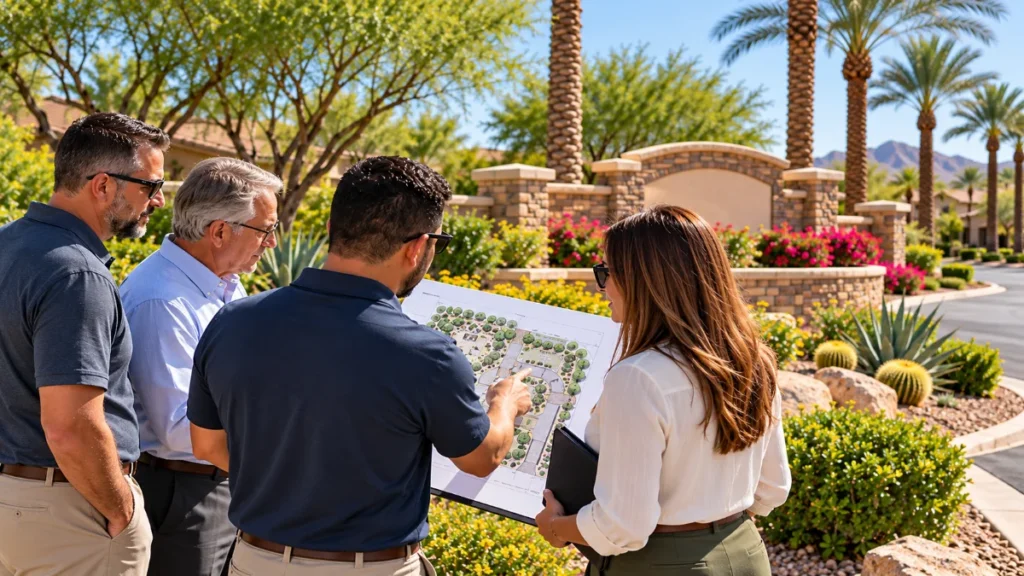
HOA landscape upgrades do not have to become one large renovation project.
For many communities, the better approach is to divide improvements into phases based on risk, visibility, resident impact, and long-term value.
This helps boards avoid the two most common mistakes: spending the annual landscape budget on cosmetic work while irrigation and safety problems remain unresolved, or delaying every improvement because the community cannot afford to renovate the entire property at once.
A phased landscape plan gives the board a practical middle ground.
Urgent problems are corrected first. High-visibility areas start looking better early. The board can then schedule larger upgrades across future budget cycles without losing sight of the overall direction.
This guide explains how HOA boards and community managers can phase landscape improvements in Phoenix without overwhelming the annual budget.
Begin With a Property-Wide Assessment
Before choosing projects, walk the entire community and separate routine maintenance issues from true improvement needs.
Routine maintenance includes weed control, regular pruning, debris cleanup, and scheduled mowing. Improvements are conditions weekly service alone won’t fix, such as failing irrigation, dead plant zones, worn decorative rock, outdated entrances, declining turf, or plants that have outgrown their spaces.
The assessment should also identify safety concerns, high-complaint areas, and places where the community repeatedly spends money without fixing the root cause.
The goal is to build one list before deciding which projects make the first budget year.
Phase One Should Address Risk and Water Loss
The first phase should protect the community from avoidable damage and liability.
Active irrigation leaks, broken mainlines, standing water near walkways, badly damaged trees, blocked visibility, unstable branches, and severe erosion belong near the top of the list.
These problems can become more expensive when delayed.
Phoenix irrigation failures can also damage surrounding plants and turf quickly during hot weather. Repairing the system before adding new landscaping protects future investments.
Boards should resist using the improvement budget for new flowers or decorative features while basic water delivery or safety remains unreliable.
Entrances Usually Deliver the Fastest Visible Improvement
Once urgent problems are controlled, the main entrance is often the strongest place to invest next.
Residents pass it every day. Visitors and prospective buyers see it first. A relatively small area can influence how the entire community feels.
Entrance work may include replacing plants, improving monument visibility, correcting irrigation, refreshing decorative rock, cleaning bed edges, adding selective seasonal color, clearing trees, and removing plants that no longer fit.
This does not require a full redesign.
A focused entrance upgrade can create visible progress for residents while the board continues planning broader work.
Replace Repeatedly Failing Plants Before Adding More
A plant that dies once may be a normal replacement.
A bed that loses the same plants every year is a system problem.
Before spending more money, determine whether the cause is irrigation, reflected heat, poor drainage, soil, plant selection, or lack of space.
Phase plans should prioritize recurring failure areas because they quietly consume maintenance budgets without improving the community.
The long-term solution may be a different plant palette, fewer plants, better irrigation, or a redesigned bed rather than replacing the same material again.
Common Areas Should Follow Resident Use
Not every common area needs to be upgraded at once.
Prioritize the spaces residents actually use and see most often.
Clubhouses, pools, mailbox areas, walking paths, parks, playground surroundings, and central greenbelts typically have more daily impact than remote perimeter beds.
A common area improvement should address both appearance and function. Overgrown plants may need to be replaced with material that stays clear of walkways. Dry turf may need irrigation work before restoration. Reset decorative rock where it continually moves into pedestrian areas.
The best improvements make the space easier to use and better looking.
Divide Projects Into High Risk, High Visibility, and Long Term Categories
A Practical HOA Landscape Upgrade Phasing Framework
Boards can use this framework to separate work that protects the community today from improvements that can be planned across future budget cycles.
| Priority phase | Typical projects | Why it comes here | Budget approach |
| Phase 1 High risk | Irrigation leaks, broken lines, hazardous tree work, drainage, trip or visibility conflicts | Prevents damage, water loss, and safety concerns | Fund first even if cosmetic work must wait |
| Phase 2 High visibility | Entrances, monument beds, leasing or clubhouse areas, major common spaces | Creates visible progress and resident confidence | Concentrate spending where the community sees it most |
| Phase 3 Recurring failures | Dead plant zones, poor irrigation coverage, tired beds, declining turf sections | Stops repeated replacement and complaint cycles | Fix root cause before reinstalling material |
| Phase 4 Broader enhancements | Rock refreshes, phased plant upgrades, turf conversion, shade trees, lower visibility areas | Improves long-term appearance and water efficiency | Spread across annual budget cycles |
Build a Three-Year View Even If the Budget Is Annual
HOA budgets are usually approved one year at a time, but the landscape should be planned on a longer horizon.
A three-year view helps the board avoid isolated projects that do not work together.
Year one might repair irrigation and update the main entrance. Year two may address high-use common areas and declining plant beds. Year three may convert selected turf or refresh decorative rock across larger sections of the property.
The exact sequence will vary, but the board can show residents that improvements are part of a plan rather than random spending.
Longer planning also helps the landscape vendor design each phase so the next one doesn’t have to undo it.
Use a Reserve Style Mindset for Larger Landscape Assets
Large irrigation systems, mature trees, monument landscapes, and major common areas are long-lived assets.
Boards should think beyond the routine landscape maintenance line item when planning for them.
A major irrigation replacement or community-wide tree program may be too large to absorb comfortably in one operating year. Identifying likely future needs early lets the board budget, reserve, or phase the work instead of waiting for an emergency.
The goal is not to create unnecessary spending.
It is to reduce surprise spending.
Separate Must Do Work From Nice to Have Enhancements
Boards make better decisions when they classify every proposal before approval.
Irrigation leaking is a must-do item. A dead shrub at the monument may be a high-visibility replacement. A decorative accent feature that would be attractive but solves no current problem is a lower-priority enhancement.
This simple distinction prevents the budget from being consumed by whichever proposal arrives first.
It also makes board discussions easier because members can compare projects by purpose rather than personal preference.
Bundle Similar Work When It Reduces Cost
Phasing does not mean every improvement should become a tiny individual project.
Some work is more efficient when grouped.
If several entrance beds need new rock, mobilizing once may make more sense than completing them separately. If multiple trees require planned clearance, one coordinated tree service may be more efficient. If an irrigation zone will be rebuilt, nearby plant replacement may be scheduled after the system is corrected.
The board should ask where bundling creates real savings without forcing lower priority work into the current year.
Do Not Install New Landscaping Over a Failing Irrigation System
This is one of the most important budget protections.
New plants, turf, or seasonal color should not be installed until the irrigation serving that area has been tested and corrected.
Otherwise, the community may pay for the upgrade and then pay again to replace plants damaged by poor water coverage.
In Phoenix, irrigation is the infrastructure behind almost every landscape improvement.
The board should treat it that way.
Use High Visibility Projects to Build Resident Support
Residents are more likely to support a multi-year plan when they can see progress.
That does not mean the board should choose appearance over safety.
It means that after addressing urgent infrastructure, at least one visible improvement can demonstrate the value of the program.
A refreshed entrance, healthier monument beds, improved clubhouse landscaping, or cleaner common area can make the broader plan easier to communicate.
Visible progress reduces the feeling that landscape spending disappears into maintenance without improving the community.
Plan Plant Replacement Around Mature Size
HOA beds become expensive when too many plants were installed originally, or the wrong species were chosen for the available space.
New phases should avoid repeating that pattern.
Select plants for mature size, sun exposure, irrigation needs, pedestrian clearance, and the area’s visual role.
Fewer, well-placed plants can often look better and require less pruning than a crowded bed.
This reduces long-term maintenance pressure after the upgrade.
Decide Where Turf Still Makes Sense
Turf can be valuable in parks, play areas, pet spaces, and active common areas.
It may be less valuable in narrow medians, steep slopes, unused corners, and small strips surrounded by pavement.
A phased HOA landscape plan can preserve functional lawn while gradually converting lower-value turf to lower-water landscaping.
This avoids the cost and disruption of removing all turf at once and gives the board time to evaluate how converted areas perform.
Coordinate Phases With Phoenix Seasons
Timing can improve both project success and budgeting.
Major irrigation work should ideally be completed before peak summer when possible. Tree reviews are especially valuable before monsoon season. Planting plans should consider heat, establishment needs, and the species being installed.
Boards should ask the landscape contractor which projects are sensitive to season and which can be scheduled flexibly.
This helps prevent a budget deadline from forcing work into a poor installation window.
Require Clear Proposals for Each Phase
Each upgrade proposal should explain the problem, the recommended work, why it belongs in the current phase, what irrigation changes are required, and what future maintenance the improvement will need.
The board should be able to tell whether the project solves a recurring issue or simply changes appearance.
Clear proposals also make it easier to compare alternatives.
A more expensive option may provide better long-term value if it eliminates repeated replacement or water waste.
Keep a Running Improvement List
Not every good idea needs immediate approval.
Maintain a running list of future work with rough priority and estimated timing.
If a lower-priority area starts declining faster than expected, it can move forward. When a project turns out to be less urgent, it can move back.
This living list gives the board flexibility without losing the long-term plan.
It also prevents improvement ideas from disappearing when board members or community managers change.
Measure Whether Each Phase Solved the Original Problem
After a project is completed, review it.
Did the irrigation repair stop the dry zone? Did the new entrance plants survive summer? Did the common area become easier to maintain? Did resident complaints decline? Is decorative rock staying in place?
This feedback helps the board make better decisions in the next phase.
A phased plan is especially useful because the community can learn from each completed area before repeating the same approach property-wide.
Final Thoughts
HOA landscape upgrades do not need to compete with the entire annual budget at once.
The strongest plan begins with a complete assessment, fixes high-risk irrigation and safety problems first, improves the most visible areas next, corrects recurring failure zones, and then spreads larger enhancements across future budget cycles.
This lets the community protect what it already owns while showing steady, visible improvement.
For Phoenix HOAs, phasing also creates an opportunity to improve irrigation efficiency, replace failing plants with better choices, preserve valuable trees, and reduce repeated maintenance problems over time.
The goal isn’t to complete everything this year.
The goal is to ensure every year’s spending moves the community toward a better landscape.
Frequently Asked Questions
Start with safety, irrigation leaks, drainage, and other high-risk issues. Then improve entrances and high-visibility common areas before moving to broader enhancements.
Yes. A multi-year plan is often the most practical way to improve large communities while keeping annual spending manageable.
After addressing urgent safety and irrigation problems, the entrance is often the next priority because it’s highly visible and shapes resident and visitor impressions.
New landscape material depends on reliable water delivery. Installing plants over a failing system can create replacement costs soon after the upgrade.
Identify why plants are failing before reinstalling them. Irrigation, heat exposure, drainage, poor plant selection, or lack of space may be the real cause.
No. Functional turf can remain in parks and active common areas, while lower-value lawn sections can be converted gradually if water use or maintenance is a concern.