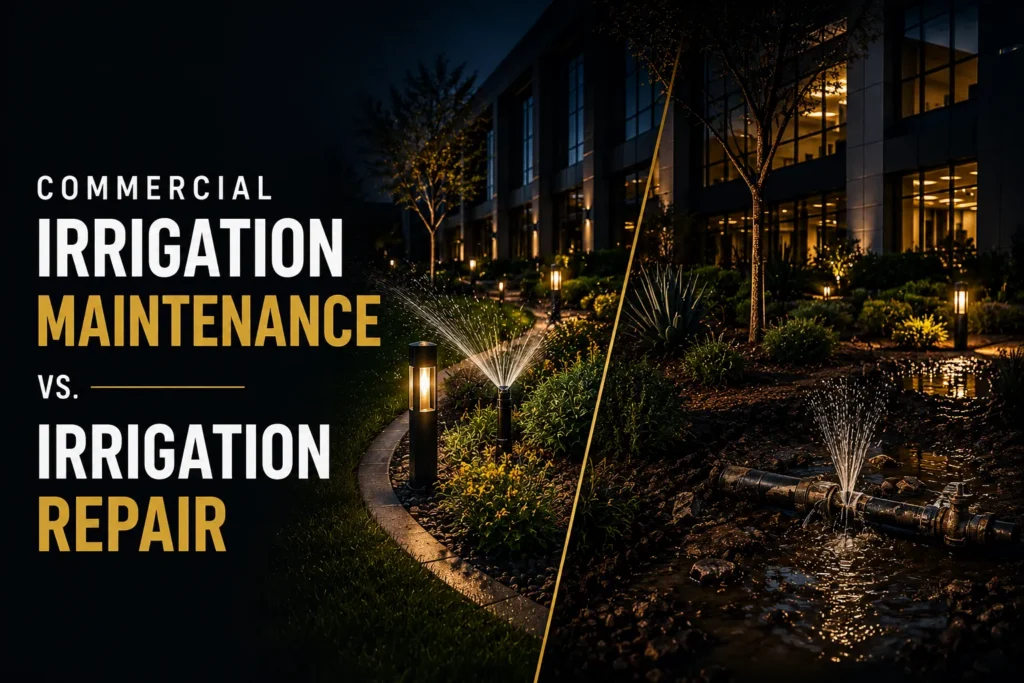
Commercial irrigation maintenance and repair handle distinct issues.
Maintenance helps avoid system failures.
Repair is required after a failure has occurred.
Both maintenance and repair are essential for Phoenix property managers. Irrigation systems may seem functional while hidden issues develop underground, in valve boxes, drip lines, or sprinkler zones. By the time symptoms such as dry turf, dying plants, standing water, or high water bills appear, repairs may already be necessary. Irrigation maintenance helps catch those problems earlier.
This guide describes the differences between commercial irrigation maintenance and repair, details typical services, and explains why both are necessary to protect landscapes and manage long-term water costs in Phoenix.
What Is Commercial Irrigation Maintenance?
Commercial irrigation maintenance involves ongoing inspection and adjustment of the system to prevent major failures.
The purpose is to ensure water reaches the appropriate areas in the correct amounts. It requires checking how the system performs rather than waiting for visible damage.
During maintenance, technicians may find a leaning sprinkler head, a partially clogged emitter, a valve not opening properly, or a controller schedule out of sync with seasonal needs.
These issues may not appear serious initially.
However, in Phoenix, these issues can escalate quickly. Early maintenance allows property managers to tackle minor problems before they lead to turf loss, plant stress, water waste, or costly repairs.
What Is Commercial Irrigation Repair?
Commercial irrigation repair resolves specific system breakdowns or broken components.
Repair is required when a component is broken, leaking, malfunctioning, or not delivering water properly.
Typical problems include broken sprinkler heads, damaged irrigation lines, failed valves, controller malfunctions, pressure problems, leaking fittings, or damaged drip tubing.
The goal of repair is to restore proper system function.
Some repairs are minor and can be completed quickly, while others require troubleshooting across entire irrigation zones to identify the root cause. For example, dry turf may appear to be a sprinkler issue, but the underlying problem could be low pressure from an underground leak. Proper diagnosis matters.
Maintenance Is Preventive While Repair Is Reactive
The primary difference is timing.
Irrigation maintenance occurs before significant landscape impact.
Irrigation repair takes place after a problem develops.
A property manager who notices one sprinkler head spraying slightly off target during a routine inspection may be able to correct it before turf begins drying out.
If the problem is ignored for several weeks during Phoenix summer, that same issue may lead to brown turf, additional watering, resident complaints, and restoration work.
The earliest irrigation problem may still be inexpensive; however, the resulting landscape damage may not be.
Valve Checks Are an Important Part of Maintenance
Irrigation valves control water flow to individual landscape zones.
When valves operate correctly, each zone receives water according to the controller schedule.
As valves age, they may begin leaking, sticking, opening partially, or failing to close completely.
Routine irrigation maintenance should watch for signs of valve trouble before the entire zone is affected.
A weak valve may reduce water pressure and leave sprinkler heads unable to cover their intended areas. A leaking valve may keep a landscape bed wet even when irrigation is turned off.
Once a valve fails, irrigation repair is usually necessary.
Early valve inspections help reduce the chance of that happening during peak summer demand.
Controller Programming Needs Seasonal Attention
Commercial irrigation controllers should not be programmed once and forgotten.
Phoenix landscapes have different watering demands throughout the year.
A schedule that works during cooler months may be inadequate during summer. A summer schedule may use far more water than necessary once temperatures begin dropping.
Commercial irrigation maintenance should include reviewing controller settings when seasons change.
Property managers should ensure zones run as scheduled, watering durations are appropriate, and programs do not overlap.
Controller problems can affect an entire property at once.
If the controller is malfunctioning or no longer communicating correctly with the system, repair or replacement may be required.
Sprinkler Coverage Should Be Checked Before Dry Spots Appear
Sprinkler heads gradually change position over time.
They may tilt, clog, become buried, suffer equipment damage, or have their spray blocked by growing plants.
These changes reduce coverage.
Routine irrigation maintenance looks for uneven spray patterns before the turf begins showing obvious stress.
A working sprinkler head does not automatically mean the area is receiving enough water.
The spray needs to reach the intended area evenly.
If coverage problems are ignored, increasing run times may overwater healthy areas while the poorly covered sections remain dry. Proper maintenance corrects the coverage problem instead of simply adding more water.
Drip Lines Need Regular Inspection Too
Drip irrigation is widely used throughout Phoenix commercial landscapes because it delivers water directly to shrubs, trees, palms, and desert plant material.
The challenge is that many drip problems are difficult to see.
Tubing may break below decorative rock. Emitters may clog. Lines may move away from the root zone. Landscape work may accidentally cut or disconnect tubing.
The system can appear normal while individual plants slowly lose water.
Routine irrigation maintenance should verify that plants are receiving water, not just that the irrigation zone is operating. If a drip line is damaged or leaking, irrigation repair may be needed before plant stress spreads.
Leaks Can Require Both Maintenance and Repair
Leaks are a good example of why maintenance and repair work together.
Maintenance helps identify the leak.
Repair fixes it.
A small irrigation leak may first appear as unusually moist soil, decorative rock that never dries, a soft patch near a valve box, or an unexplained increase in water use.
Detecting those signs during a routine inspection allows the leak to be repaired early.
If it continues unnoticed, the property may experience higher water bills, reduced system pressure, erosion, plant damage, or standing water.
Hidden leaks can be especially expensive on large commercial properties because they may continue for long periods before anyone sees obvious water.
Pressure Problems Can Affect Large Areas
Proper pressure is necessary for an irrigation system to deliver water evenly.
Low pressure can prevent sprinkler heads from rising fully or reaching their intended distance. High pressure can create misting, overspray, faster component wear, and unnecessary water loss.
Pressure problems may come from leaks, valve issues, system design problems, broken components, or changes somewhere else on the property.
Routine maintenance can identify unusual pressure before the landscape shows widespread stress.
If a failed part or damaged line causes pressure, irrigation repair becomes necessary.
Dry Zones Should Never Be Solved by Guessing
Dry zones are one of the most common irrigation complaints on commercial properties.
The temptation is to increase watering.
That is not always the right answer.
A clogged sprinkler head, a damaged drip line, a pressure issue, a failed valve, an incorrect controller setting, or poor sprinkler coverage could cause a dry area.
Increasing irrigation time without finding the cause may waste water and create problems elsewhere.
A proper inspection should identify why the area is dry.
Once the cause is identified, determine if the issue needs an adjustment, ongoing maintenance, or irrigation repair. Water Waste Is Often a Maintenance Problem First
Water waste does not always begin with a major system failure.
It often starts with small issues.
A sprinkler head may spray pavement. A controller may run longer than necessary. A drip emitter may leak beneath decorative rock. A valve may slowly seep water after the cycle ends.
Routine irrigation maintenance catches these flaws.
When they are ignored, they can turn into expensive utility costs and larger repair issues.
For Phoenix commercial properties, where summer irrigation demand is already high, controlling unnecessary water use can make a notable difference in operating expenses.
Why Phoenix Commercial Properties Need Ongoing Inspections
Phoenix creates very little margin for irrigation mistakes during summer.
Turf, shrubs, trees, palms, and landscape beds rely heavily on irrigation when temperatures remain high for long periods.
A system failure in cooler weather may take time to become visible.
The same failure during summer can damage plants quickly.
Commercial properties also tend to have larger and more complicated irrigation systems than residential properties. There may be many valves, controllers, sprinkler zones, drip lines, and landscape types spread across the site.
This complexity heightens the significance of ongoing inspections.
The purpose is not to constantly repair the system.
It is to prevent small failures from becoming large ones.
What Happens When Irrigation Maintenance Is Delayed
Deferred irrigation maintenance usually increases risk.
A small sprinkler coverage issue can become dead turf.
A clogged emitter can become a dead shrub.
A slow leak can become a high water bill.
A weak valve can become an entire dry zone.
A controller problem can affect multiple parts of the property at once.
The cost then goes beyond irrigation repair.
Property managers may need to pay for plant replacement, turf recovery, tree care, erosion repair, or additional landscape work.
Irrigation maintenance should be considered essential protection for the entire landscape budget.
Commercial Properties Still Need Repairs Even With Good Maintenance
Preventive maintenance cannot eliminate every irrigation failure.
Sprinkler heads break. Valves wear out. Underground lines crack. Controllers eventually fail. Vehicles, mowing crews, construction, or normal aging can damage equipment.
A well-maintained system will still require repairs.
The difference is that problems are more likely to be caught earlier.
Good maintenance also gives the irrigation technician better information about the system, making it easier to detect recurring problems and determine whether a larger upgrade may eventually make sense.
When Should Property Managers Request an Irrigation Inspection?
Property managers should consider an irrigation inspection when they notice changes in landscape performance or water use.
That may include dry turf, stressed shrubs, standing water, uneven irrigation, broken heads, runoff, declining trees, low pressure, unexpected controller behavior, or rising utility bills.
Properties should also be reviewed before the most demanding summer months.
Finding a weak valve or coverage problem before extreme heat arrives is much easier than trying to recover damaged landscaping afterward.
When Does the Property Need Irrigation Repair?
Repair should be scheduled when a component is damaged or the system cannot perform correctly through normal adjustment.
Examples include broken sprinkler heads, leaking or cracked lines, failed valves, damaged drip tubing, controller failures, and pressure problems caused by broken equipment.
Active leaks and large dry zones should be treated quickly.
If the issue is affecting mature trees, entrances, common areas, turf, or other valuable landscape features, waiting can increase the final cost substantially.
Maintenance and Repair Should Work Together
Commercial irrigation maintenance and irrigation repair should not be treated as competing services.
A strong irrigation program uses both.
Maintenance identifies developing problems, improves system efficiency, adjusts seasonal performance, and reduces preventable failures.
Repair restores broken components when failures happen.
Together, they help property managers protect water use, landscape appearance, plant health, and long-term maintenance budgets.
Final Thoughts
The difference between commercial irrigation maintenance and irrigation repair comes down to prevention and response.
Maintenance keeps the system working properly through scheduled inspections, controller adjustments, valve checks, sprinkler coverage reviews, drip line monitoring, leak detection, and pressure observation.
Repair becomes necessary when a component breaks or the irrigation system can no longer deliver water correctly.
Phoenix commercial properties need both.
Waiting until turf turns brown, plants begin dying, or water bills rise usually means the irrigation problem has already started affecting the rest of the landscape.
Periodic inspections help property managers find those issues sooner.
And when something does fail, timely irrigation repair prevents a manageable problem from becoming expensive landscape damage.
Frequently Asked Questions
Irrigation maintenance focuses on inspections, adjustments, and early problem detection. Irrigation repair fixes broken or malfunctioning parts of the system.
Commercial irrigation maintenance may include checking valves, controller settings, sprinkler coverage, drip lines, leaks, pressure, dry zones, and signs of water waste.
Inspection frequency depends on property size, system age, and season, but Phoenix commercial properties benefit from routine monitoring and additional attention before and during summer.
No. Components can still wear out or become damaged, but routine maintenance can identify problems earlier and reduce the risk of larger failures.
Irrigation repair should be scheduled when there are active leaks, broken sprinkler heads, valve failures, damaged lines, controller problems, low pressure, or recurring dry zones.